
The Perfect Remedy
The Process of Bioremediation
The basic principle of bioremediation is to clean up waste using microorganisms. This means that the two most important factors for bioremediation to work are: microorganisms must survive in high numbers and microorganisms must be highly metabolically active. The question is, where does biotechnology come into play? Using biotechnology, we can genetically modify and mass produce these microorganisms to be used for more efficient bioremediation. Bioremediation can be done in two different ways; and
(2.0)
(2.1)
In Situ
In Situ involves treating a contaminated area on site. In soil contamination, microorganisms are added directly to the soil in order to speed up the process of hazardous materials decomposition. In Situ Bioremediation allows for contaminants to be completely destroyed, with lower risk for site workers, and lower equipment and operating costs. (2.2)
 Oil Spill Cleanup |  In Situ Process |
|---|
Ex Situ
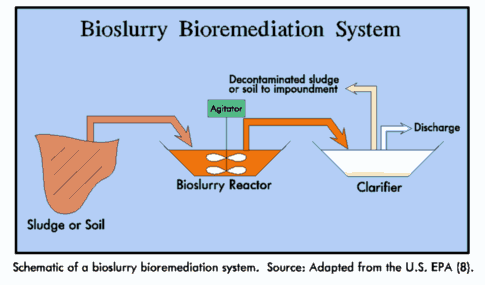 BioSlurry (2.4)Slurry Phase bioremediation pumps contaminated soil to be cleaned in a bioreactor. The liquid phase is then drained out in the clarifier stage and the decontaminated soil is discharged back into the environment. |  Biopiling Sillery (2.5)Contaminated soil is excavated and spread over a prepared bed and periodically tilled until pollutants are degraded. | 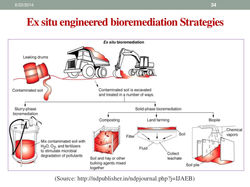 Ex Situ Strategies (2.6)An overview of an Ex Situ engineered strategy |
|---|
Slurry phase bioremediation involves mixing the contaminated soil with water and other reagents in a bioreactor. Within the bioreactor, oxygen and other nutrients are then mixed in which allows the microorganisms to work in optimal conditions to break down the waste within the soil. The water is then eventually drained and the soil is tested and returned to the environment. (2.2)
Solid Phase Bioremediation treats contaminated soil in an above ground center. Conditions within the center are at optimal conditions in order to ensure quick remediation, although it’s not as fast as slurry phase bioremediation. Common practices of solid phase bioremediation are landfarming, soil biopiles, and compost. (2.2)